
I’ve been thinking about this for awhile, and now here I am—bringing my commonplace book back online. My intention is create a space where all those detailed internal conversations I have about whatever it is I’m reading or observing at the moment can be allowed room to live and grow and breathe again. So we’ll see how it goes…
Silk Brocade — Tessa Hadley
Reply
The first piece of fiction I read after finishing Reading Like a Writer was a short story by Tessa Hadley in a New Yorker from last summer 1.
I generally don’t like short stories. Most seem gimicky, or thin, or written according to some stylebook I’m immediately suspicious of. Short fiction often leaves me hungry to know more, feel more, understand more. I get to the end, note the sharp shock of emotion or understanding, appreciate how we got there at the end of they leave me many more unanswerd questions with a there’s not enough there
Time Travel
My site got blasted by some random EMR and words from nine years ago appeared wondering how they got back to top-of-mind again. Don’t know. Think I’ll rebuild the site (all formatting etc. was trashed) and perhaps more will be revealed.
Paper Doll – Robert B. Parker
I’m reading Robert B. Parker’s Spenser series in semi-random order. They’re pretty formulaic but quite often provide a hearty belly-laugh or two. What I didn’t expect was this novel, which from the very beginning you can tell is somewhat different: there are long paragraphs, some which go on for half a page! This was the fourth book of his that I read, and I wasn’t truly familiar with his entire range yet; but I was so used to pages and pages of one-line wise-guy dialog that it seemed like I’d strayed somehow into another author’s work with the exact same characters.
This was Parker’s 20th novel, published in 1993, and it just had more weight to it that the later ones that I’d read so far: the plot, the psychological depth, and the just-plain-old drama and pathos (in the best sense of those words). Also, I’d already started catching the literary allusions, so when I got to the end of Chapter 45 and saw this line, I just had to look it up:
Human voices wake us, and we drown.
Sure enough, it’s also the last line of T. S. Eliot’s “The Love Song of Alfred J. Prufrock.” Not only was it completely appropriate to the action, but it pushed the over into it’s on special category.
How to Avoid Making Art – Julia Cameron
Yes, it’s The Artist’s Way and Vein of Gold author — telling me how to avoid making art? OK, I’ll bite.
So I did. And then I threw the book across the room.
I really hate this book. I mean I really really hate it. I hate it so much that I bought a copy and sent it to my brother with a note that said “this book really pissed me off; I’m wondering if you have the same reaction.”
Well, he did. Except he said “thank you for the awesome book” etc.
Can you use “Proustian moment” in a sentence?
Ever since someone said that phrase to me in the lobby of the Living Computer Museum in Seattle (a place that offers many such moments for anyone who’s worked in high tech), I’ve been on the lookout for a chance to use it myself. Thanks to Reading Like a Writer, I now can. In the first chapter, where the author is defining “close reading,” she mentions that her French lit classes used an equivalent term: explication de texte.
And what a delicious Proustian moment it was, to read that phrase. I was swept away, swooning, to a wine-soaked summer French Intensive at UC Santa Cruz–so many, many years ago. Thank you, Francine Prose.
Reading Like a Writer — Francine Prose
I’m not sure how this book ended up in my reading pile, but it may have been the subtitle: “A guide for people who love books and for those to want to write them.” What kept me reading was the first chapter, “Close Reading,” where I was delighted to discover that Prose and I did our stint in academia around the same time. How strange and wonderful to find a book published in 2006 that unabashedly favors “reading what [is] on the page with only passing reference to the biography of the writer or the period in which the text was written.”
Just to be clear, she’s not trying to make a case for the return of the New Criticism, or deny the validity of social or political context. What she is trying to do is answer the question that begins this book: “Can creative writing be taught?” And “close reading” is what she offers as an answer.
So I really wanted to like this book. But the author made it very difficult.
What goes here
I’m going to pretend that I haven’t had a long hiatus, and just continue on…
When the novelist is a poet and her narrator is too
One of the most enjoyable things about reading Tana French’s novels is her wonderful language. I’ve been thinking a little though about whether or not the vivid, sensory voice always fits with her characters.
Take, for example, Broken Harbor‘s narrator Scorcher Kennedy. A driven and compulsive murder detective, he has (no big surprise in a Tana French book) a terrible childhood secret that, when revealed, does a lot to explain his manic-defense-mode working style and his need to alphabetize his bookshelves. OK, he reads, but check out this description of early-morning drive back into Dublin from a mostly-abandoned housing development thirty minutes outside of town:
The haunted blackness of the estate, scaffolding bones looming up out of nowhere, stark against the stars; then the smooth speed of the motorway, cat’s-eyes flicking in and out of existence and the moon keeping pace off to one side, huge and watchful; then, gradually, the colors and movement of town building up around us, drunks and fast-food joints, the world coming back to life outside our sealed windows. (p. 169)
My dysfunctional relationship with ‘WhirlyWord’
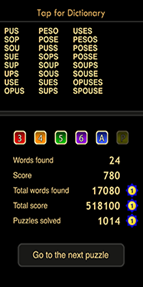 In the morning I like a little zone-out time while I’m waking up and thinking about the day. One of my most long-running distractions is an iPhone word game app called WhirlyWord. The reason I say my relationship with it is dysfunctional is because I’m constantly talking back to it about the limits and quirkiness of the dictionary. Pet peeves: leaving out common words, redacting anything the least bit “unsuitable” or rude, and yet including obscure botanical and medical terms.
But I’ve been playing it since December 2012, and even though I accidentally reset my progress a while back and had to start over, the number of puzzles has keep me interested (and muttering under my breath) for all this time.
The Bilingual Brain
This morning during my workout at the Y I responded to something my trainer said with “claro que si !” This happens frequently and is quite unconscious; I can never predict when or where I might insert some stock French or Spanish phrase into conversations with people who I know don’t speak either of those languages. What the heck is that all about?
Today’s example at the gym left me wondering if I shouldn’t dig up some of the second-language acquisition studies we looked at when I was getting my ESL degree. I found the stuff about growing up bilingual particularly fascinating, and even though I learned both of my second languages after the so-called “age of plasticity” (puberty or so, when the brain starts losing its ability to just absorb stuff without any effort) there might be some insights there into my somewhat puzzling spontaneous utterances.
On the other hand, maybe I’ll just chalk it up to a harmless eccentricity, and move on to something else.