My dysfunctional relationship with ‘WhirlyWord’

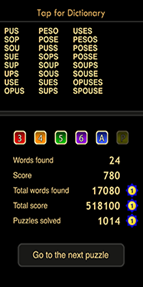
In the morning I like a little zone-out time while I’m waking up and thinking about the day. One of my most long-running distractions is an iPhone word game app called WhirlyWord. The reason I say my relationship with it is dysfunctional is because I’m constantly talking back to it about the limits and quirkiness of the dictionary. Pet peeves: leaving out common words, redacting anything the least bit “unsuitable” or rude, and yet including obscure botanical and medical terms.

But I’ve been playing it since December 2012, and even though I accidentally reset my progress a while back and had to start over, the number of puzzles has keep me interested (and muttering under my breath) for all this time.


The Bilingual Brain

This morning during my workout at the Y I responded to something my trainer said with “claro que si !” This happens frequently and is quite unconscious; I can never predict when or where I might insert some stock French or Spanish phrase into conversations with people who I know don’t speak either of those languages. What the heck is that all about?

Today’s example at the gym left me wondering if I shouldn’t dig up some of the second-language acquisition studies we looked at when I was getting my ESL degree. I found the stuff about growing up bilingual particularly fascinating, and even though I learned both of my second languages after the so-called “age of plasticity” (puberty or so, when the brain starts losing its ability to just absorb stuff without any effort) there might be some insights there into my somewhat puzzling spontaneous utterances.

On the other hand, maybe I’ll just chalk it up to a harmless eccentricity, and move on to something else.

Philip Kerr shadowing Raymond Chandler

I’ve been reading Philip Kerr’s Bernie Gunther series–crime stories set (mostly) in Germany during the Third Reich and its aftermath. It’s serious historical fiction, but the main character is a hard-boiled wise-cracking detective, delightfully written and howlingly funny at times, even when his smart remarks get him in trouble with the Nazis (whom he hates, and secretly works against every chance he gets).

I knew Kerr was modeling Bernie’s character and voice on 40’s crime fiction. After all, the first three Bernie Gunther novels were reissued in a one-volume Penguin edition under the title Berlin Noir. Curious to see just to see how much of a resemblance there really was, I picked up a copy of The Big Sleep, Raymond Chandler’s first Phillip Marlow story.

Continue reading

Critters in the attic

Aside

One of the important plot points in Tana French’s novel Broken Harbor involves an unknown animal or animals supposedly invading the attic of one character’s house, terrorizing the children and causing the husband to engage in increasingly irrational behavior.

While I was reading these sections we starting hearing rats in our attic again for the first time in four years. (We feed birds. We’re going to have critters. And they’re eventually going to get in.) We’ve called the exterminators and the bill is going to be a big one this time around, since it involves ripping out all the insulation and plastic in the crawl space. And I still don’t know what they’re going to do about the attic, and how they’re going to get past all that blown-in insulation.

This was all bad news. But seriously, the worst part of the  whole experience was reading Tana French’s creepily evocative descriptions of mysterious animal noises in the attic while hearing them in my own house. No fair! Really!

Broken Harbor — Tana French

I started reading Tana French’s books at the beginning of December, and just finished the last one, Broken Harbor. Looking back it seems like there should have been more than just four others; I figure that’s because they’re so dense and full.

Perhaps it’s a cliché of police procedurals and psychological thrillers–the damaged cop driven by self-loathing and dark hidden secrets. French however turns up the intensity level. She goes so deeply into each person’s motivations and feelings, with such an intricate and plausible level of detail, that at times it can be almost overwhelming.

Her gorgeous writing is an important part of this; she’s a poet and don’t I know it. However, the total effect does leave me wondering how realistic it is to have a murder detective who is so self-aware. If he feels everything so strongly as she describes, it’s amazing that he hasn’t given in to his frequent thoughts of suicide (an important theme in this book for other reasons).

When I think about the…case, from deep inside endless nights, this is the moment I remember. Everything else, every other slip and stumble along the way, could have been redeemed. This is the one I clench tight because of how sharp it slices. Cold still air, a weak ray of sun glowing on the wall outside the window, smell of stale bread and apples.

There’s at least one other example I want to cite but can’t find it at the moment. I also want to come back to the narrative structure of her books — usually a story told in retrospect. Often there is foreshadowing similar to the excerpt above; sometimes it’s successful, and some times it’s not.

I’ve ordered all four of her other books again from the library, and will be writing more about her work later.

The Lost Colony – John Scalzi

These aren’t bad books necessarily; some of the plot elements do verge over into space opera territory, and not in a pleasing or fresh way like (for example) the Ann Leckie books. But there’s just something about the overall effect — not a seamless immersive whole but a too-present sense that you can just see and hear the clanking machinery that supposedly makes the whole thing work. I always want to read the next book in the series when I finish, but just in a vaguely curious way, not like I’m bereft at leaving the world or hungry to return to it like some other authors.

Why doctors need technical writers

I had a colonoscopy last Friday, and it took me quite a while to understand the report they sent home. Particularly annoying was the section that describes how to determine when you’ll have to go through the entire ordeal again: “Recommend repeat colonoscopy in three years if three or more polyps are adenomatous.” What am I supposed to do with that? Look it up, I guess.

So here’s what I found out. There are three types of polyps that can develop in the colon. One, a type of benign tumor called an adenoma, is considered pre-cancerous. So if you have enough of them you have to come back sooner in order to lower your risk of colon cancer.  OK, well why didn’t you say so in the first place?

There’s one sentence in the results section that I’m still not able to parse, even after looking up every word. (A problem common to beginning readers and language learners, now that I think of it.)

Patent functional end-to-end colo-colonic anastomosis, characterized by healthy appearing mucosa.

I think that just means my gut can still move things along the way it’s supposed. One of the not-insignificant burdens of aging, to even have to consider such things. But healthy is good. And gratitude’s the attitude.

The Blue Notebook returns

Featured

I’ve been thinking about this for awhile, and now here I am—bringing my commonplace book back online. My intention is create a space where all those detailed internal conversations I have about whatever it is I’m reading or observing at the moment can be allowed room to live and grow and breathe again. So we’ll see how it goes…